Reading the pattern in a petrified wood pendant
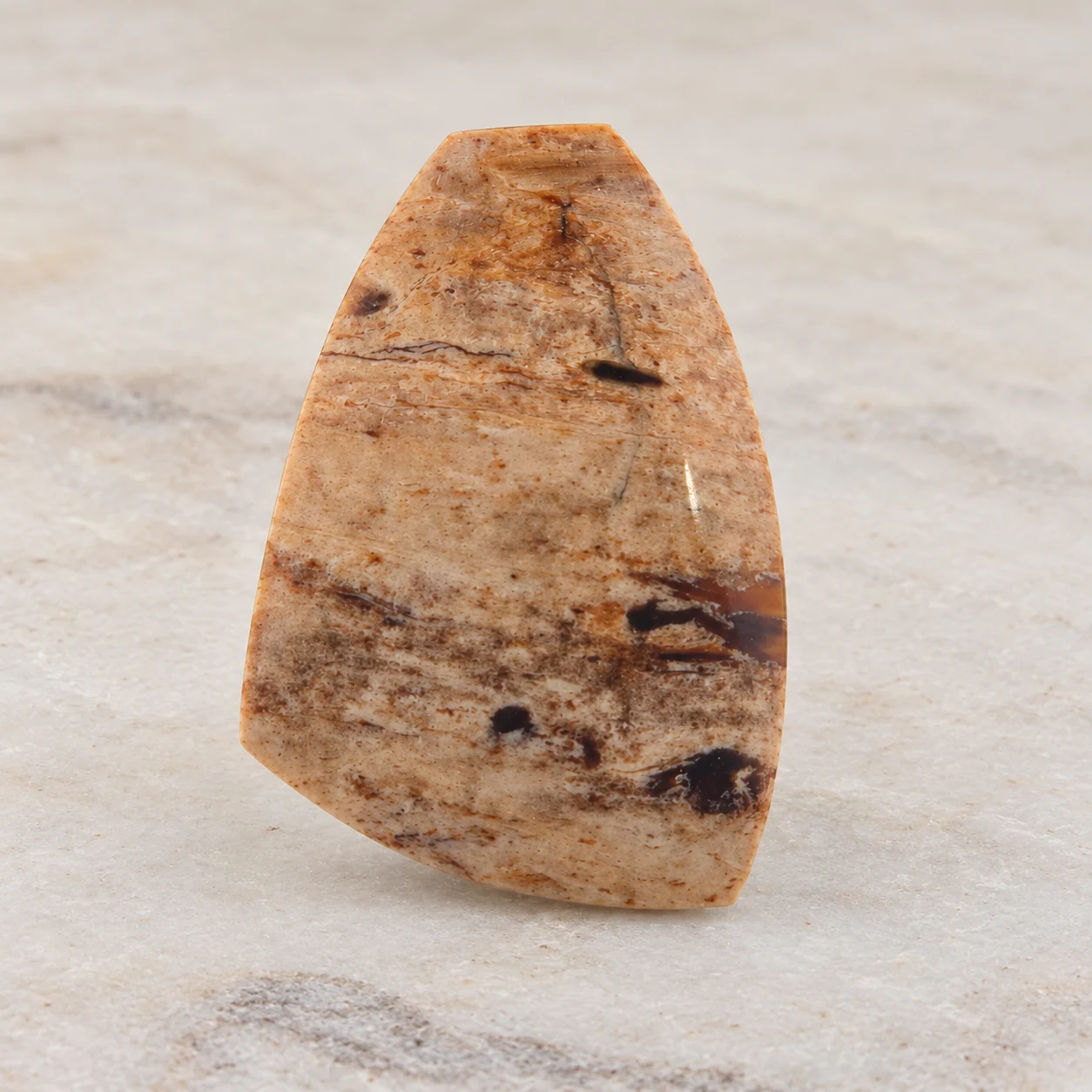
This cabochon starts with a quiet palette: pale tan, warm brown, and fine dark markings. Its interest comes from the way those marks gather, thin out, and change direction across the face.
How wood becomes stone
Petrified wood preserves a connection to a once-living tree through mineralization. The National Park Service describes two processes that often occur together: minerals fill pores in buried organic material, called permineralization, and minerals take the place of original material, called replacement. Silica is common in this process, and some examples preserve details down to the cellular scale.[1]
That geological story helps explain why a polished piece can have a wood-like pattern while being worked as stone. It does not tell us the species, age, or source of every cabochon. For the piece pictured here, we use the broad name petrified wood; we are not assigning it a particular tree species or geological age.
A familiar-looking grain can tempt us to fill in the missing story. When buying, separate what the listing documents from what the pattern reminds you of. An attractive resemblance to palm, bark, or a landscape can be part of the enjoyment without becoming a claim about identification.
Follow the marks across this piece
Look first at the pale area near the top. Fine dark lines and small marks sit against the tan background. Farther down, the darker areas become more prominent, especially on the right side. The pattern is uneven, leaving some parts open and gathering more densely in others.
That unevenness gives the cabochon a visual direction. The eye can move from the quieter upper area toward the broader, darker lower portion. It is an observation about this piece, not a description every petrified wood cabochon will share.
For a useful comparison, cover part of the photograph with your hand, then uncover it. See how much the darker area changes the balance. When a stone has a very small palette, the placement of its markings often becomes the feature that distinguishes one piece from another.
What the tapered shape contributes
The top of this cabochon is narrower than its base. Its sides widen gently, ending in a broad rounded lower edge. That outline gives the lower pattern room to spread while keeping the top visually contained. The shape and the distribution of the markings work together.
If you are planning a custom petrified wood pendant, start by deciding what you like about the material. Is it a fine, fairly even grain-like texture? A strong contrast between dark and light? A broad marking that you want to keep visible? Those preferences can guide a discussion about the cut.
An elongated outline may suit a pattern you want to follow vertically. A wider freeform may give an irregular area more room. Neither is automatically the best choice: the actual material matters. In the designer, selecting the maker’s choice of freeform shape allows the outline to respond to the stone.
Choosing a piece to wear or give
Tan and brown are a useful starting point for someone who already wears warm neutrals. Look at the clothes and jewelry they return to most often. A pale petrified wood cabochon may be more visible against a dark top; on a light one, its outline and darker markings can become more noticeable.
Choose the format around how the recipient will use it. A loose cabochon can suit a collector or jewelry maker. A bail-only pendant works for someone with a favorite chain. A complete necklace gives them both pieces together. Check the dimensions and ruler photograph rather than judging size from the close-up alone.
For a unique gift, the most meaningful explanation may be a simple visual one: the pattern reminded you of a trail, a piece of weathered wood, or the colors they like. Keep that personal association in the gift note, and let the material information stay accurate. The piece can carry both a geological history and your own reason for choosing it.