Read the whole necklace: chain, bail, and all
A necklace has more than one part, and the small print should not require a magnifying glass. The stone may get the photograph, but the chain and bail each bring their own material label. Read those labels one component at a time and the choice becomes much simpler.
Start with the object being described
Jewelry labels become easier when you find the noun first. In “solid 14kt gold chain,” the noun is chain. In “18kt gold plated bail,” the noun is bail. The words before it describe that one object, not every metal part attached nearby.
This matters because a complete necklace is an assembly: stone, bail, and chain. Think of a small cast where everyone has a separate résumé. A solid gold chain does not quietly promote the bail to solid gold, and a plated bail does not change what the chain is made from.
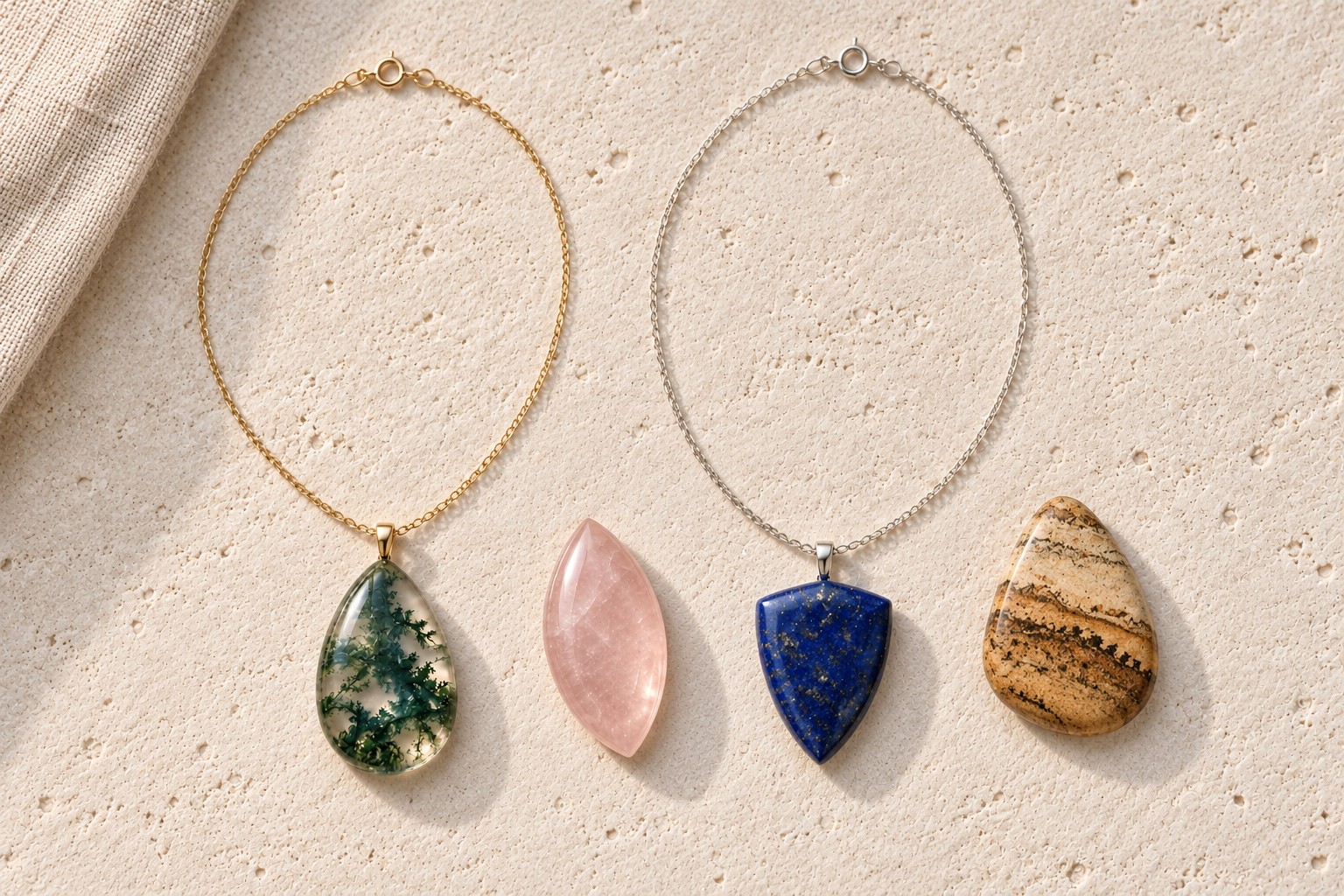
Color is useful for choosing an appearance, but it is not a material test. The representative image above shows gold-colored and silver-colored finishes. A photograph can show their general effect beside a stone. It cannot tell you whether a gold-colored component is solid gold or plated over another material.
Read the three chain labels literally
Loveletter Stones currently offers three 18-inch cable-chain materials. The first is solid .925 sterling silver. The second is 18kt gold plated over .925 sterling silver, which means the chain has a sterling silver base with an 18kt gold coating. The third is solid 14kt gold.
Each chain is available in 0.8, 1.0, and 1.2 mm widths. Width and material answer different questions. The millimeter number describes how fine or visible the chain is; it does not change silver into gold or plating into solid metal. Choose the material, then choose the width.
The phrase “gold plated over .925 sterling silver” is longer because it names both the surface and the base. Shortening it to “gold chain” would remove the most useful part of the description. Likewise, “solid 14kt gold” belongs to that specific chain option. It does not describe the entire finished necklace.
The bail gets its own line
The bail is the attachment that lets the stone hang from the chain. On these pendants it is attached to the back with epoxy, leaving the stone’s edges visible. It is a separate component with a separate material choice.
A solid .925 sterling silver chain uses a solid .925 sterling silver bail. Both gold chain choices use an 18kt gold plated bail. That includes the solid 14kt gold chain. There is no solid gold bail option in the current designer.
The site does not identify a base metal for the gold plated bail, so this article will not guess one. “18kt gold plated” is the complete supported description. If your requirement is an entirely solid-gold chain-and-bail combination, the current options do not provide it. Better to learn that before checkout than after the necklace has acquired a very tiny identity crisis.
Choose by the detail you care about most
If you want a silver composition, the solid .925 sterling silver chain and matching sterling silver bail give you the clearest answer. If you want a gold-colored finish with a sterling silver chain underneath, choose the 18kt gold plated over .925 sterling silver chain; its bail is also described as 18kt gold plated.
If the chain itself must be solid gold, choose the solid 14kt gold chain while remembering that its bail remains 18kt gold plated. That can be a perfectly acceptable combination when the chain material is the priority. It simply should not be described as an entirely solid-gold necklace.
Before ordering, finish one sentence for each part: “The chain is…,” “the bail is…,” and “the bail attaches by….” For the solid-gold-chain option, the accurate answer is: the chain is solid 14kt gold, the bail is 18kt gold plated, and the bail attaches to the back of the stone with epoxy. Three short answers are clearer than one impressive-sounding phrase spread over the whole piece.