Moss agate: a tiny garden that never needs watering
Moss agate can look like a miniature garden, mercifully beyond the reach of anyone’s plant-care record. In the representative image, fine green branches cross milky open areas while darker clouds seem to sit deeper in the stone. The garden is a useful way to look. It is not what is physically growing there.
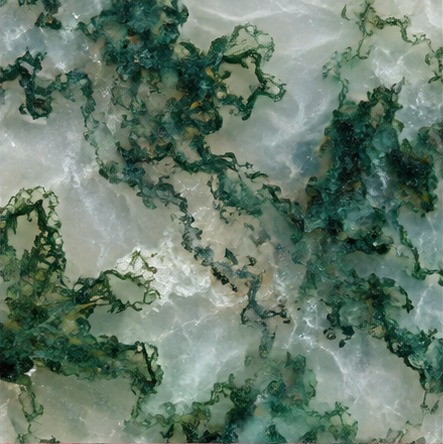
The moss is a resemblance, not a plant
Moss agate is a form of chalcedony, the fine-grained quartz material that also appears in other kinds of agate. The Smithsonian describes chalcedony as fine-grained quartz built from thin layers of fibrous quartz crystals. “Moss” is the visual name we give the branching pattern, not a claim that leaves or roots were preserved inside the stone.[1]
GIA uses “inclusion” for material within a host gemstone, including mineral crystals as well as fluid- or gas-filled cavities. Those inclusions can differ in shape, color, contrast, and orientation. That is why a green line in moss agate can branch like a stem while still being entirely mineral.[2]
The comparison remains useful if we keep the labels straight. A dark fork may resemble a twig. A soft green patch may look like something seen through fog. Those are honest descriptions of appearance. Calling them actual moss would turn a good metaphor into bad botany.
Open-looking does not mean empty
The pale areas in the image give the darker pattern room to be seen, but they are not blank holes. They belong to the host chalcedony. Some look milky white, some gray-green, and some seem brighter because the photographed surface is returning light. “Open-looking” is the careful description; “perfectly clear” would ask more of this image than it can prove.
GIA notes that inclusions can affect a gem’s transparency and may occur randomly, along color zones, or along healed fractures. It also explains that identifying what an inclusion is can require microscopy and other testing. A photograph can show us the pattern’s visible character, but color alone cannot identify every green mineral inside an untested piece.[2]
Translucency also changes with lighting. Front light emphasizes surface polish and color. Light passing through a thinner area can make overlapping inclusions easier to separate. A pendant worn against a dark shirt may show more silhouette and contrast; held near a bright window, the same stone may reveal additional pale layers. Neither view is the single official version of the stone.
Choose the kind of depth you enjoy
When considering a particular moss agate piece, look beyond the familiar garden resemblance. Do you enjoy fine branches you can follow, soft clouds with uncertain edges, or a combination of both? Then look at the pale space around them. The open-looking areas act like pauses, making individual forks easier to read.
If a finished piece is available, its listing photographs show that individual cabochon. If the sense of depth matters to your choice, ask whether an additional view in plain front light or gentle backlight can be provided. The goal is not to make the stone perform under dramatic lighting. It is to see whether the branches remain interesting in the conditions where you are likely to notice them.
For a custom design, the current moss agate image is a material example rather than a pattern order form. Notes such as “I like a mix of fine branches and softer green clouds” communicate a visual preference without requesting a copy of the photograph. The actual material will decide where every fork and pale window appears. Fortunately, tiny gardens are allowed to ignore the landscaping plan.