Fordite: a color record from the paint shop
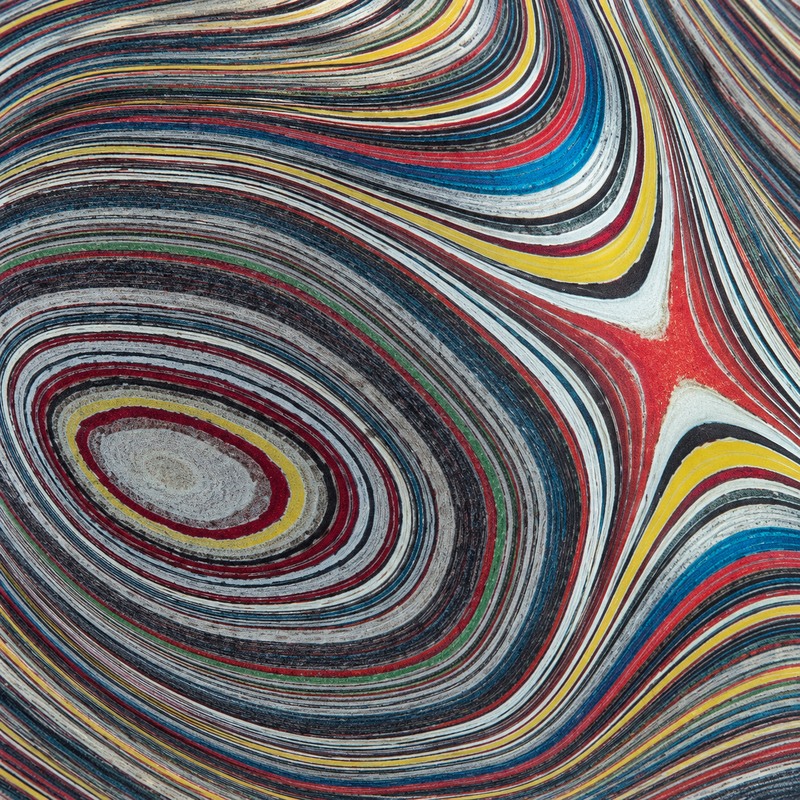
Follow one thin yellow line through a Fordite pattern. It may sweep across a broad curve, tighten around an oval, then disappear at the edge. The color belongs to a layer of paint, revealed by the cut.
A material with an industrial beginning
Fordite is layered automotive paint used as a decorative lapidary material. In a documented example from a Corvette assembly plant, the Gemological Institute of America describes paint overspray accumulating on the equipment that carried car bodies through painting. The deposits passed through curing ovens with the bodies and were eventually removed. Cutting into the accumulated layers exposed the patterns used in finished pieces.[1]
You may also see the name Detroit agate. That name is a trade nickname, not a mineral identification or proof that every piece came from Detroit. GIA’s example came from Bowling Green, Kentucky. A particular factory, car model, or production year needs evidence tied to the material being sold.[1]
For our material selection, enjoy the paint-layer story without assigning an undocumented factory or date to your piece. If a specific provenance matters to you as a collector or as part of a gift, ask what is known about that particular material before ordering.
Look for the pattern inside the pattern
In the image above, an oval of pale gray sits near the lower left. Narrow red and yellow outlines circle it, followed by a much wider field of dark bands. Toward the right, the layers open into larger white, red, and blue curves. The image contains both a focal point and a direction of movement.
Those are two useful things to look for when choosing a Fordite pendant. A small enclosed shape can act like the center of a composition. Long, sweeping bands can guide the eye from one end of the piece to the other. You might prefer a cabochon that keeps one complete oval, or one that shows only a section of a much larger curve.
Color balance matters as much as the number of colors. A piece with a broad gray field and a few thin yellow lines can read quite differently from one dominated by red and white, even when both contain the same palette. Try looking at the image from farther away. Which color remains most noticeable?
Choose an outline that gives the layers room
An oval can echo an enclosed band pattern. A rectangle can place a firm boundary around sweeping lines. A freeform outline gives the maker more freedom to respond to the individual material. These are design possibilities, not guarantees that a chosen pattern will fit inside a particular shape.
For a custom Fordite piece, notes about your preferences are more useful than asking for the texture preview to be copied. You could write, “I like broad blue areas,” or “I prefer fine bands with a small oval pattern.” The available material and the practical cut determine what can be achieved.
If a very specific arrangement of lines is what attracts you, a finished cabochon is easier to choose from photographs: the pattern, outline, and proportions are already visible. A material selection in the custom designer shows the character of Fordite, while the piece made for you will have its own arrangement.
A personal gift for someone who notices color
The automotive connection offers one starting point for a gift, but the visual appeal can be enough on its own. Someone who likes graphic prints, strong color combinations, or objects with an unusual material history may appreciate Fordite without being a car enthusiast.
Choose the chain color by looking at the broad areas in the material rather than trying to match every stripe. A silver-colored finish can work with cool gray, white, and blue; a gold-colored finish can pick up yellow or warmer tones. Keep the chain simple if the bands are the main attraction.
For a gift note, be specific about the choice you made. Mention the curve you liked, the color that reminded you of the recipient, or their interest in how things are made. That explanation gives the one-of-a-kind pattern a personal connection without needing a factory story you cannot verify.