Tiger’s eye: the stripe that won’t sit still
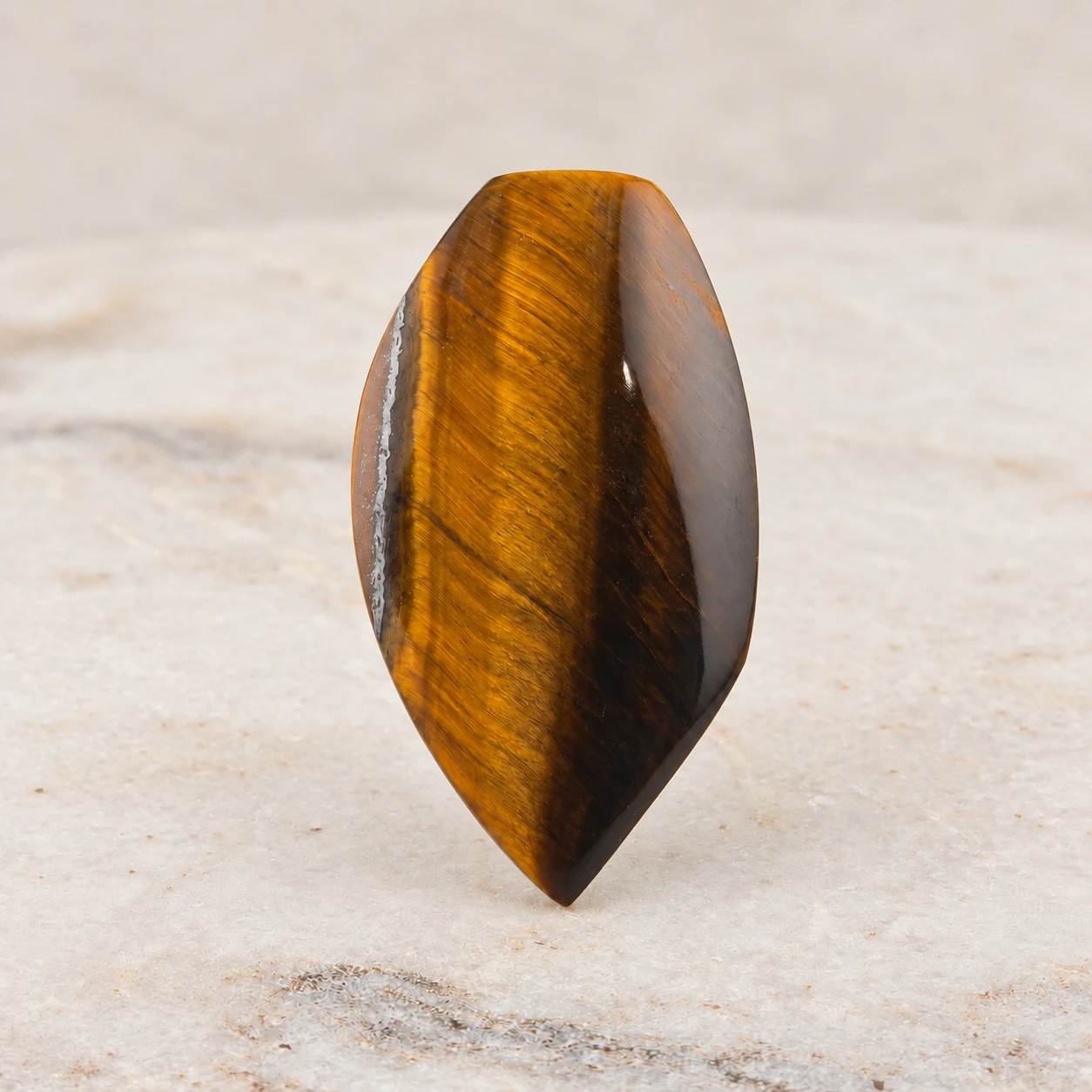
In the full-view photograph, a warm gold stripe crosses the face of this tiger’s eye while a deep brown band holds the right edge. It looks as if the stripe was painted onto the stone. It was not, and under different light it will not politely stay there.
The stripe is reflected light
Gemologists call this effect chatoyancy. The Gemological Institute of America describes it as a narrow band or line of reflected light on a cabochon that moves as the stone rotates in relation to the light. Parallel needle-like inclusions or fibrous textures organize that reflection instead of scattering it evenly across the surface.[1]
Tiger’s eye is a chatoyant variety of quartz. GIA’s museum description compares its sheen with silk and explains that light reflected from its golden quartz fibers creates the effect. Cutting and polishing the material with a broad curved face gives that organized reflection room to become visible.[2]
Think of sunlight crossing a row of closed blinds. The slats stay where they are, but the bright path changes when you move. In tiger’s eye, the fine structure belongs to the material. The bright stripe is the temporary part, produced by the relationship among stone, light, and viewer.
First find what stays put
The approved photographs of our Tiger’s Eye Leaf Cabochon show two kinds of information at once. Fine diagonal lines run across the face, and a broad dark brown area follows the right side. Those are useful fixed landmarks. The glowing gold region is how the stone is returning the studio light from that particular position.
Across the full-view and ruler photographs, the leaf outline, diagonal structure, and dark side remain recognizable. The lighting and orientation are similar, so the images do not provide a dramatic before-and-after sequence of the moving stripe. That is an honest limit, not a flaw in the stone. Three still photographs taken in nearly the same setup remain three frozen moments.
This distinction also keeps an ordinary surface reflection from causing confusion. A polished cabochon can show a small bright reflection from the lamp or room. Chatoyancy reads more like a silky band within the stone’s patterned face. In a still image, use that description as a clue rather than demanding a courtroom confession from one white highlight.
Give each photograph one job
Use the full-view image to study the stone’s warm gold and brown palette, pointed leaf outline, and the placement of its darker band. Use the ruler photographs for scale. They also confirm that the same diagonal structure continues across the face, but their main purpose is measurement, not a special-lighting demonstration.
A still can tell you whether you like the fixed composition even when the stripe is quiet. That matters because tiger’s eye will not look equally bright from every seat, window, or late-night kitchen light. If you enjoy the brown-and-gold pattern before asking it to perform, the changing sheen becomes a pleasure rather than a requirement that every room must satisfy.
What a still cannot show is the full path, width, or intensity of the band as the angle changes. It cannot guarantee that the exact bright area pictured will remain in that location while the pendant is worn. Treat the photograph as one good sentence about the stone, not the entire biography.
If the movement matters, ask for a useful video
A short video can answer the motion question better than a stack of nearly identical photographs. The useful version is simple: one steady light, no color filter, and a slow tilt from side to side and then top to bottom. Keeping the camera and lamp reasonably still makes it easier to see which change comes from the stone’s angle.
If chatoyancy is the reason you are choosing a particular finished piece, ask whether a short clip of that piece can be provided before you buy. Be specific about what you want to see: the light band traveling across the face, not a fast spin with dramatic music and twelve edits. Tiger’s eye already has enough production value.
When comparing pieces in person, the same test works. Hold the stone under a single overhead or window light and tilt it slowly. Watch the bright band, then return to the starting angle. The fixed pattern should come back into the same arrangement while the reflected stripe travels with the light. That small movement is the whole point.