How big is a two-inch pendant, really?
A close-up can make a cabochon look like a paperweight. Then the ruler photo appears and the same stone suddenly looks as if it might fit in a coat pocket. Neither impression is very useful on its own.
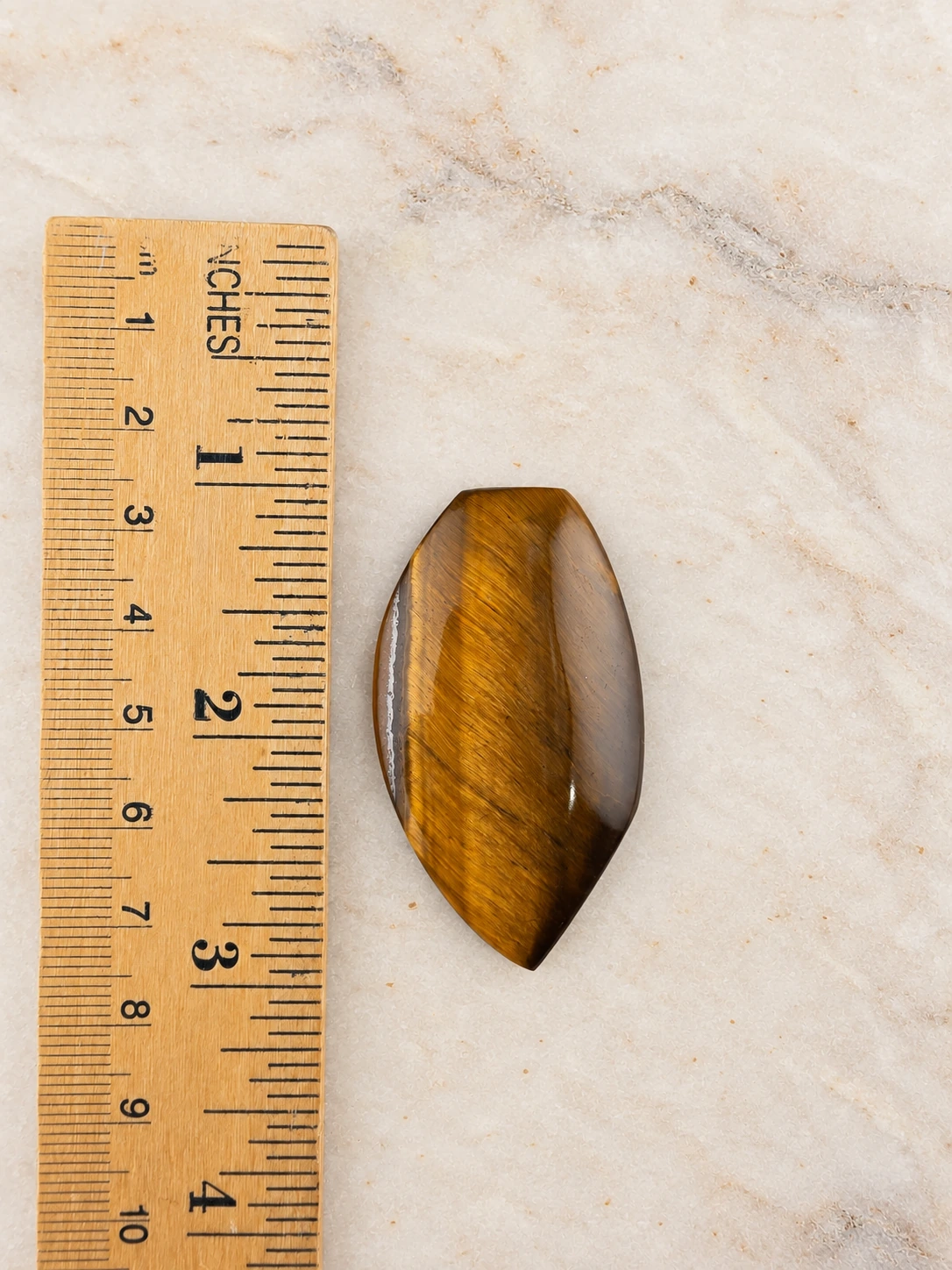
Start with two numbers, not one
Our Tiger’s Eye Leaf Cabochon is approximately 48 mm high and 28 mm wide. In inches, that is about 1.89 by 1.10. Calling it a “two-inch pendant” is a useful shortcut, but it tells you only the longest dimension. It does not tell you whether the piece is narrow, broad, round, or shaped like a tiny serving platter.
The 48 mm height gives this stone length. The 28 mm width tells you it keeps a relatively lean outline. Compare that with the round Peanut Obsidian cabochon in the shop, which measures approximately 37 by 37 mm. The round piece is shorter, but its full width continues across the middle. One reads as elongated; the other has more visual weight from side to side.
That is why height and width belong together. If you look only at the larger number, two very different silhouettes can sound almost the same.
The paper test takes about a minute
Cut a small piece of ordinary paper to 48 by 28 mm. If your ruler speaks inches, use roughly 1.9 by 1.1 inches. Trim it into a simple leaf or long oval rather than leaving it as a rectangle. The shape does not have to be elegant. This is a fitting-room ticket, not an audition for art school.
Hold the paper near the center of a shirt or place it beside a pendant you already own. Step back from the mirror. Up close, a few millimeters can feel important; from normal conversation distance, the overall silhouette usually does more of the talking.
Try the paper against two different necklines. A pendant that feels substantial against bare skin can appear quieter over a patterned sweater. The test will not predict an exact fit or hanging position, but it answers the most useful first question: does this amount of stone feel small, comfortable, or intentionally bold to you?
The stone is not the full hanging length
The listed 48 × 28 mm measurements describe the face of this cabochon. They exclude the bail attached behind the stone. Once a bail is added, the finished pendant will hang a little longer than the stone itself. We do not add a generic number because the final amount depends on the bail and how it sits on that individual piece.
The chain introduces another variable. The same pendant can land differently depending on the wearer, clothing, and where an 18-inch chain rests on them. Our on-model view is an approximate scale reference, not a promise that the necklace will occupy one exact spot on every person.
Use the ruler photos for the stone’s actual face dimensions. Use the model preview to understand general scale and finish. They are two different tools, and asking either one to do both jobs is how a perfectly reasonable pendant ends up looking suspiciously enormous at 11:30 at night.
For a custom piece, choose a neighborhood
The custom designer groups the longest dimension into three ranges: small at 0.5 to 1.5 inches, mid at 1.5 to 2.5 inches, and large at 2.5 to 4 inches. Those are useful size neighborhoods. They are not a promise that every finished stone will land on the same precise fraction of an inch.
A nearly two-inch stone sits within the mid range. Before choosing that range, make paper versions at 1.5, 2, and 2.5 inches using roughly the kind of outline you want. A two-inch narrow oval and a two-inch square do not feel equally large, even though the tape measure gives them the same headline.
For a finished shop piece, the work is easier because its outline and measurements are already set. Check the full-view photograph for shape, the ruler photographs for scale, and the model preview for a general sense of how the finished piece may read. Three views, three jobs, and much less guessing.